Hear from people doing the work
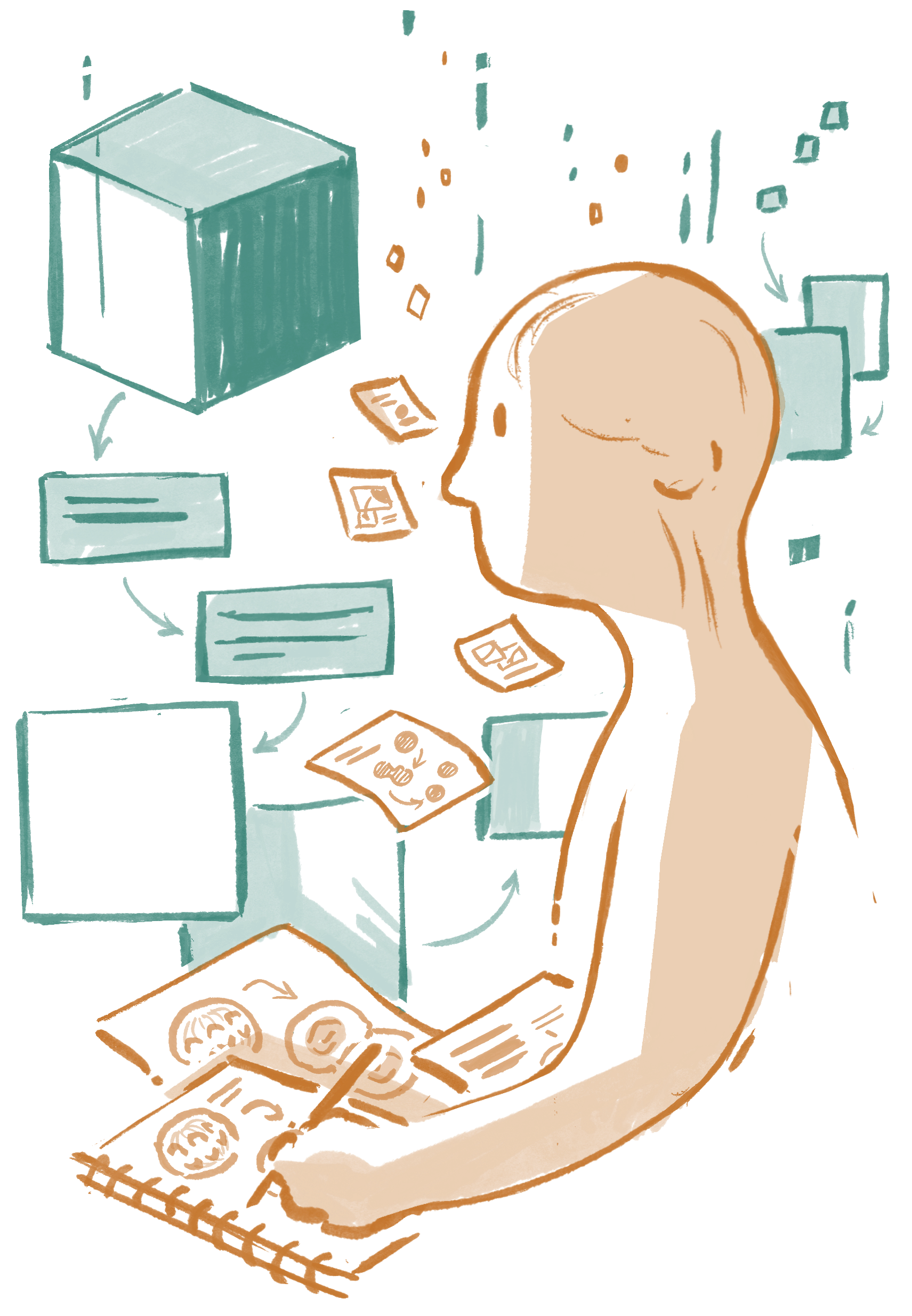
Industry leaders, practitioners, educators, and researchers sharing what they’re seeing, testing, questioning, and changing in response to generative AI.
November 21, 2026
Exploring AI in
medical illustration
A one-day in-person symposium bringing together practitioners, industry leaders, educators and students to investigate and discuss the implications of generative AI in the field of medical illustration.
Hosted by the Master of Science in Biomedical Communications with the Institute of Medical Science, University of Toronto

Generative AI is changing how medical and scientific images are imagined, produced, revised, and delivered. For practitioners, educators, and students, the questions are no longer hypothetical: What should we use these tools for? What should we refuse? And what happens to the expertise, authorship, accuracy, and craft at the centre of our work?
DRAWING THE LINE creates space to examine those questions together, with practical examples, critical discussion, and perspectives from across our industry. We hope attendees will leave with a clearer understanding of the current landscape, a deeper sense of the challenges and opportunities ahead, and connections with others navigating this uncertain territory.
Industry leaders, practitioners, educators, and researchers sharing what they’re seeing, testing, questioning, and changing in response to generative AI.
Short talks unpacking how these systems work, legal and ethical questions around their use, the current tool landscape, and what may be at stake for our profession.
Facilitated roundtables focused on what is changing in studios, agencies, and day-to-day workflows.
Lightning talks featuring experiments, workflows, successes, failures, and questions from across medical and scientific visualization.
An open conversation about adoption, business models, changing roles, and the difficult questions around jobs and the future of the profession.
A closing reflection on what we might gain, what we might lose, and how we can move forward intentionally.
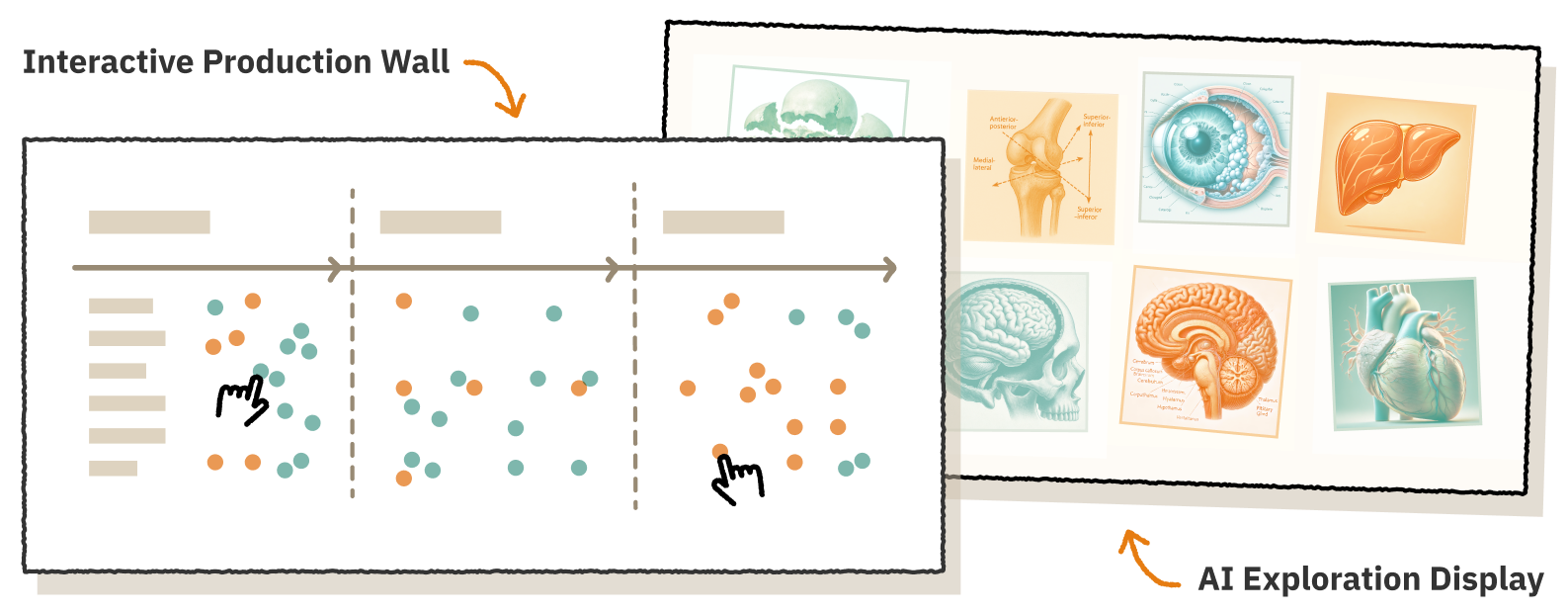
Beyond the sessions, two visually engaging displays run through out the day. The Interactive Production Wall is an evolving map of how attendees are (or are not) incorporating AI into workflows, from research to execution, constructed by attendees throughout the day. The AI Exploration Display is an open space to post visuals from your own experiments—successful or otherwise, or any other AI-associated visual content *.
*Can include layouts, sketches, screengrabs of prompts used or shortcuts applied for rendering efficiency, finals, contrasting human/AI-created images, etc.; print and mount your piece (extra Velcro will be supplied onsite); max size 18”h x 24”w; include a separate explanatory tag with name/company, production details (e.g., AI tool/image generator used), etc. Exhibit space is limited and cannot be guaranteed.
Generative AI and creative work–Shm opens the day's conversation with the fundamental questions: how is generative AI changing creative work and what should we do about it? From reshaping creative processes to expanding what is possible and transforming the role of the practitioner, GenAI is changing what we create and how we create it. This talk explores how we can respond with intention–embracing new possibilities while making deliberate choices about the tools, practices, and creative communities we want to build.
 Shm ("shim") Garanganao Almeda
A series of short talks establishing what the room needs to hold in common: how these models work, what the tool landscape looks like from chat interfaces to node-based pipelines, where copyright and authorship currently stand in Canada and the US, the societal and environmental cost including labour, and what is lost for the practitioner.
 Joe Samson
 Nick Woolridge
 Sania Khurshid
 Shay Saharan
Facilitated roundtables on what has actually changed in your day-to-day over the past year: what clients and employers are asking for now that they weren’t before, what has shifted in timelines, rates, and scope, and what the work looks like from here. Groups are mixed deliberately, so expect to be at a table with people who see this differently than you do.
 Derek Ng
A series of lightning talks, seven minutes each with three
minutes of questions, in which practitioners describe how
they are actually exploring or using generative AI in their
work. Case studies are drawn from across the production
pipeline and not limited to visual output.
Have an idea for a lightning talk? Submit here!
 Details coming soon (October 2026)
 Michael Corrin
Industry specialists–from studio leaders to sole practitioners–will discuss the perceptions and operational implications of AI in biomedical visualization. From client demands and legal restrictions to in-house experiments and creative problem-solving, the conversation will evolve through varying topics, including those proposed by registrants.
 Desmond Ballance
 Katie McCormack
 Kevin Millar
 Azuravesta Rastan
 Jason Sharpe
 Stephen Mader
A candid, critically reflective closing conversation about where our field stands, what we’ve learned, and what remains uncertain. Rather than offering easy answers, this keynote invites us to grapple with the challenges ahead, consider what we stand to gain, and explore how we can move forward with intention, curiosity, and hope.
 Gaël McGill
The Master of Science in Biomedical Communications is hosting the Certified Medical Illustrator (CMI) exam in Toronto. The exam is administered independently of the symposium, but the timing should make travel and scheduling easier if you are doing both.
Deadline to register: November 6, 2026 at
midnight ET
Exam date: Sunday, November 22, 2026
Check-in: 8:30 AM ET
Exam: 9 AM to 2 PM ET
Location: Room 102, Old Administration Building,
University of Toronto, 263 McCaul, Toronto, ON M5T 1W7
Proctor: Dr. Shelley Wall, Associate Director,
MScBMC program
Artist, computer scientist, and creativity researcher
Shm ("shim") Garanganao Almeda is an artist, computer scientist, and creativity researcher. Shm is currently imagining new encounters with cultural collections as a postdoctoral fellow with the Smithsonian, but they were recently spotted researching HCI+AI in the UC Berkeley EECS PhD program, Adobe Research, and the Midjourney Storytelling Lab; teaching Creative Programming & Electronics at the Jacobs Design Institute; pushing new paradigms of puppetry as a Stochastic Labs resident, and driving two rabbits cross-country to NYC. shmuh.co
Founder & CEO, Digizyme, Inc.; Faculty, Harvard Medical School
Gaël McGill is Director of Molecular Visualization at Harvard Medical School, where his teaching and research focus on visualization design. He is the founder & CEO of Digizyme, Inc., a team of scientist-artists dedicated to the visualization and communication of science. Dr. McGill has authored several textbooks—Biology, Essential Cell Biology, and Molecular Biology of the Cell—as well as worked with the United Nations and the Institute for Planetary Thinking on issues of biodiversity loss and the metacrisis.
DRAWING THE LINE is open to practitioners, students, and educators working in medical and scientific visualization. Registration includes access to all sessions, the Industry Panel, and Lightning Talks on November 21, 2026 at The Conference Centre, UofT. Space is limited, so register early to lock in a spot. This symposium is being organized as a community event, with registration fees set to fund the execution of the symposium.
Student rates are for those actively enrolled in a degree or diploma program.
Registration includes breakfast, coffee breaks, and lunch, and access to all sessions, the Industry Panel, and Lightning Talks. Please note: besides water bottles, no outside food or drink is permitted in The Conference Centre.
Register through the link below. Early bird registration closes on October 16 (11:59 PM, ET). Regular registration closes November 13 (11:59 PM, ET) or when capacity is reached.
Refund policy: Cancellations will be processed subject to handling fees related to the costs of hosting the symposium. Percentage refunded: Up to October 21 = 50%. After October 21 = No refund.
Register & Purchase TicketWe're looking for contributors to talk about how they're exploring or using generative AI in their workflows. Seven minutes, followed by three minutes of questions. We plan to select eight talks. Selected speakers will be asked to share slides/visuals in advance of the session.
Treat this as a discussion of how you either 1) actually used or 2) explored AI technology, built around a case or series of experiments. We're looking for submissions that focus on the visual production pipeline in medical/scientific visualization, but not limited to visual output alone. Audio, text, and process uses all count, including work where nothing generated appears in the final deliverable.
Example topics
Who can apply: Practitioners, students, and educators are welcome to submit.
The deadline to submit a lightning talk was October 2, 2026.
Master of Science in Biomedical Communications
with the Institute of Medical Science, University of
Toronto
Co-Chairs
Stephen Mader
Shay SaharanVice-Chairs
Michael Corrin
Derek Ng Maeve Doyle
Nick Woolridge
Maeve Doyle
Nick Woolridge89 Chestnut Street, Toronto, Ontario, M5G 1R4
Transit. From St. Patrick Subway station, walk east on Dundas Street. Chestnut Street is at the first set of lights east of University Avenue. Travel time is approximately a 2 to 5 minute walk.
Parking. On-site underground parking , approximately $21 per day.
Accessibility. The Conference Centre features barrier-free entrances, wide interior pathways, accessible washrooms, and elevators equipped with low buttons, Braille markings and audible floor indicators.
From Pearson Airport. Use the UP Express. The Union Pearson (UP) Express travels between Pearson Airport and Union Station in downtown Toronto in just 28 minutes. Trains run every 15 minutes, 7 days a week. Train to city (UP Express). From Union Station, take the TTC Line 1 (Yonge-University) North. Ride for 3 stops and exit at St. Patrick Subway Station. Alternatively, airport taxis and limousines are also available at the terminals. Travel time in ideal conditions is approximately 45 minutes.
There are many places to stay near The Conference Centre. Hotel chains such as the Hilton and Sheraton are close by, as are The Holiday Inn and the Chelsea Hotel. Here are a few hotel options: